Homeowner guide

The FEMA 50% rule and remodeling in Southwest Florida

Request Your Estimate
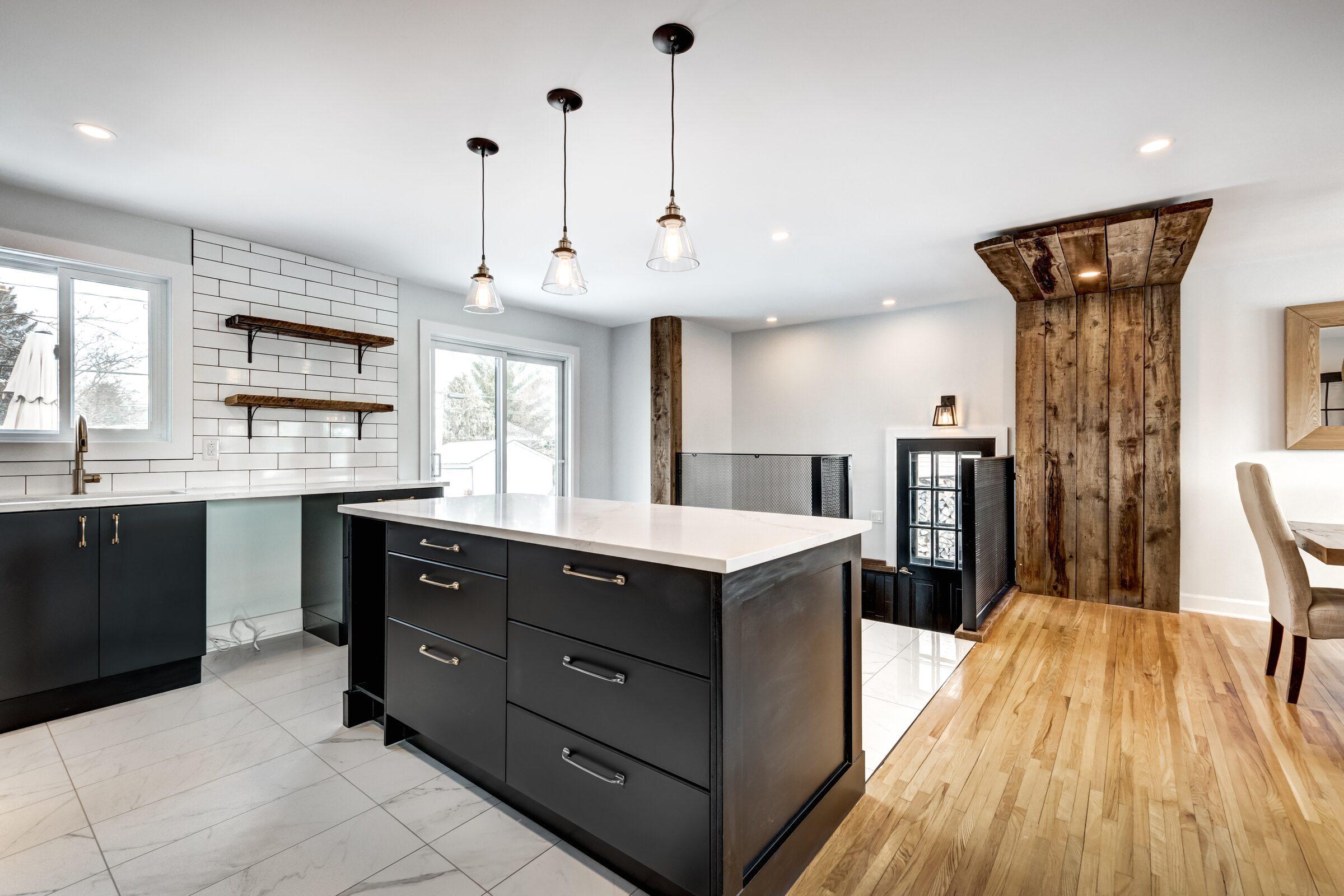
Kitchen with a black island under a white countertop, three glass pendant lights, white subway tile with open wood shelves and a rustic wood-plank wall panel

The short answer

It compares the cost of the work with the value of the building.

Applies to
Buildings in a Special Flood Hazard Area that do not meet current flood requirements
Threshold
Work costing 50% or more of the building’s market value
Decided by
Your city or county floodplain administrator
Checked

If your home is in a flood hazard area and does not meet today’s flood requirements, your city or county compares the cost of a remodel with the market value of the building, not the land. When the cost equals or exceeds 50 percent of that value, the project is a substantial improvement, and the whole building has to be brought up to current flood requirements. For a house, that chiefly means raising the lowest floor to the required flood elevation.

A home that already meets current flood requirements is generally not subject to the rule. For a home that does not, the questions are how much the building is worth for this purpose and how much the whole project will cost.

This guide covers how the rule works for interior remodeling, such as kitchens and bathrooms, in the Southwest Florida communities we serve.

The rule

What the 50% rule says

The rule comes from the National Flood Insurance Program. Federal regulations define a substantial improvement as “any reconstruction, rehabilitation, addition, or other improvement of a structure, the cost of which equals or exceeds 50 percent of the market value of the structure before the ‘start of construction’ of the improvement.”

Remodeling counts even when the outside of the house does not change. FEMA’s desk reference for local officials lists “rehabilitation or remodeling of a building with or without modifying its external dimensions” among the work that can trigger the rule.

When a project is a substantial improvement, the building must comply with the flood requirements for new construction. For homes, the federal minimum is a lowest floor at or above the base flood elevation. Lee County, Collier County, Charlotte County, and the City of Punta Gorda state the requirement as the base flood elevation plus one foot.

The same 50 percent test applies to repairs. A building is substantially damaged when the cost of restoring it to its condition before the damage would equal or exceed 50 percent of its market value, whatever caused the damage.

Your home

Which homes it applies to

Homes in a Special Flood Hazard Area

That is land with a 1 percent or greater chance of flooding in any given year, shown on FEMA’s flood maps. You can look up an address at FEMA’s Flood Map Service Center, and several local governments offer their own lookup.

Homes that are not already compliant

Lee County puts it this way: if your building is already flood compliant, the 50% rule generally does not apply. Charlotte County says a building whose lowest floor and equipment sit above the required elevation is considered compliant, and that an elevation certificate is required to show it.

Historic structures

The federal definition excludes alterations to a historic structure, provided the work does not cost the building its historic designation.

Condominiums

The test uses the value of the building. In Cape Coral, the property appraiser’s building value is not available for condominiums, so the city asks for an appraisal instead.

The value

How the building’s value is set

Only the building counts. FEMA’s guidance says the value of the land, landscaping, driveways, and detached structures is not included, so the number is lower than what the property would sell for.

Florida’s model definition gives two ways to arrive at it: the actual cash value determined by a qualified independent appraiser, or the tax assessment value adjusted to approximate market value. Local governments here generally start with the county property appraiser’s value for the building and accept an appraisal from a Florida-licensed appraiser if you disagree with it.

The details differ by office. Collier County uses the Improved Value on the property appraiser’s website, and its staff can add 20 percent to it. Charlotte County uses a value that is not listed on the property appraiser’s website and has to be requested. The City of Naples and the City of Cape Coral put limits on how old an appraisal can be.

The cost

What counts toward the cost

FEMA’s desk reference lists what a local official must include and what may be left out. The lists below are the parts that matter most to a kitchen or bathroom remodel.

Counted

  • Materials and labor, including the value of your own labor and donated materials
  • Demolition and debris disposal
  • Contractor’s overhead and profit, and sales tax on materials
  • Built-in cabinets, bathroom tile and fixtures
  • Floor and wall finishes, interior doors, and hardware
  • Plumbing fixtures and piping, electrical wiring, and light fixtures
  • Built-in appliances
  • Work needed to meet other code requirements the project triggers

Not counted

  • Plans and specifications
  • Permit and inspection fees
  • Plug-in appliances
  • Carpeting installed over finished flooring
  • Outside improvements such as landscaping, driveways, fences, pools, and pool enclosures
  • The minimum work needed to correct a code violation an official has already cited

Countertops are not named in FEMA’s list, but the cost forms used by Lee County and the City of Bonita Springs include them.

FEMA also says that if any part of the work requires a permit, all of the proposed work is counted, including the parts that would not need a permit on their own.

Earlier projects

Do past permits count?

Under the federal minimum, the test applies to each separate application. For years some Florida communities went further and added up improvements over a set period, such as five years.

Florida law changed that in 2025. Section 163.31795 of the Florida Statutes says a local government in the National Flood Insurance Program may not adopt or enforce a cumulative substantial improvement period. The City of Cape Coral told contractors in July 2025 that it would no longer consider aggregate improvements and would make determinations permit by permit.

When we checked, the published codes of the City of Fort Myers and the City of Bonita Springs still described a 12-month period and a five-year period. If your home is in either city, ask the city how it applies the rule today.

A single project still cannot be split to stay under the threshold. Bonita Springs has applicants acknowledge that separating the cost of the work into multiple permits to avoid the review is not permitted, and Charlotte County and Collier County count open permits toward the total.

Your remodel

What this means for a kitchen or bathroom remodel

Four things to find out before you plan a larger project on a home in a flood hazard area.

1. Your flood zone

Look up the address on FEMA’s flood map or your local government’s tool. If the home is not in a Special Flood Hazard Area, the rule does not apply.

2. Whether the building is compliant

An elevation certificate shows where the lowest floor sits relative to the required elevation. A compliant building is generally not subject to the 50% test.

3. The building’s value

Ask your floodplain office which value it uses. Charlotte County gives this example: with a building value of $250,000, the threshold is reached when the work costs $125,000 or more.

4. The cost of the whole project

Add up everything in the permit, not just the kitchen or the bathroom. If the total comes close to half the building’s value, talk to the floodplain office before the design goes further.

By community

Who makes the decision in each community

The determination is made by the local floodplain administrator, working with the building official. It is not made by a contractor, the homeowner, or an insurance adjuster.

Good to know

50% rule questions

01

Does the FEMA 50% rule apply to a kitchen or bathroom remodel?

It can. FEMA counts remodeling even when the outside of the building does not change. The rule applies when the home is in a Special Flood Hazard Area and does not meet current flood requirements, and the cost of all the work in the permit is compared with the market value of the building.

02

Does the 50% rule apply to every home in a flood zone?

No. Lee County states that if a building is already flood compliant, the 50% rule generally does not apply. Charlotte County requires an elevation certificate to show that a building is compliant.

03

Is the 50% based on what my home would sell for?

No. It is based on the market value of the building alone. The land, landscaping, driveways, and detached structures are left out. Local governments generally use the county property appraiser’s value for the building, or an appraisal by a Florida-licensed appraiser.

04

Do earlier projects count toward the 50%?

Florida law has barred local governments from adopting or enforcing a cumulative substantial improvement period since 2025, and Cape Coral makes determinations permit by permit. One project cannot be split across several permits to avoid the review, and some counties count permits that are still open.

05

Who decides whether my remodel is a substantial improvement?

The floodplain administrator for your city or county, working with the building official. FEMA’s guidance says local officials are responsible for the determination and that an insurance adjuster’s estimate must not be used to make it.

06

What happens if a remodel reaches 50%?

The building must be brought into compliance with current flood requirements. For a house, the federal minimum is a lowest floor at or above the base flood elevation, and several local governments here require one foot above it.

Planning a remodel?

Complete the form below or call us at (239) 295-8613 and one of our team members will be in touch to discuss your project and provide a free, no-obligation estimate.

Open form in a new tab Or call (239) 295-8613

Collaborative Construction

Let’s start your next
home remodeling project.