Stains and sealing
Quartz is non-porous and does not need sealing. Granite is porous to a degree that varies by stone, and a sealer is reapplied from time to time. When a few drops of water darken the surface instead of beading, it is time.

 Illustration
In short
Quartz and granite are the two countertop materials most homeowners choose between, and both are part of our kitchen remodeling services. Neither is the wrong answer. They behave differently, and a few of those differences matter more in Florida than elsewhere.
The materials
Quartz countertops are engineered. Ground natural quartz is mixed with resin and pigment and formed into slabs, which gives the manufacturer control over color and pattern.
Granite is natural stone, cut from a quarry in blocks, sliced into slabs, and polished. Its color and movement were set long before anyone thought about your kitchen.
Living with it
Quartz is non-porous and does not need sealing. Granite is porous to a degree that varies by stone, and a sealer is reapplied from time to time. When a few drops of water darken the surface instead of beading, it is time.
Granite tolerates a hot pan better. The resin in quartz can scorch or discolor. A trivet is the right habit with either one.
Both are hard surfaces. Edges are the vulnerable spot, at the sink and above the dishwasher, and a chip in either can usually be repaired.
Mild dish soap and water for both. Abrasive pads and harsh cleaners can dull the surface of either.
Florida
The resin in quartz can yellow or fade with prolonged direct sunlight. In most kitchens that never becomes an issue. A counter that sits in hard afternoon sun beside a wall of sliding doors deserves a conversation before you choose.
Outdoors, the answer is clearer. Most quartz is made for indoor use, and only a few manufacturers make lines rated for the outdoors. Granite is not affected by sunlight, which is one reason it is common in outdoor kitchens.
Looks
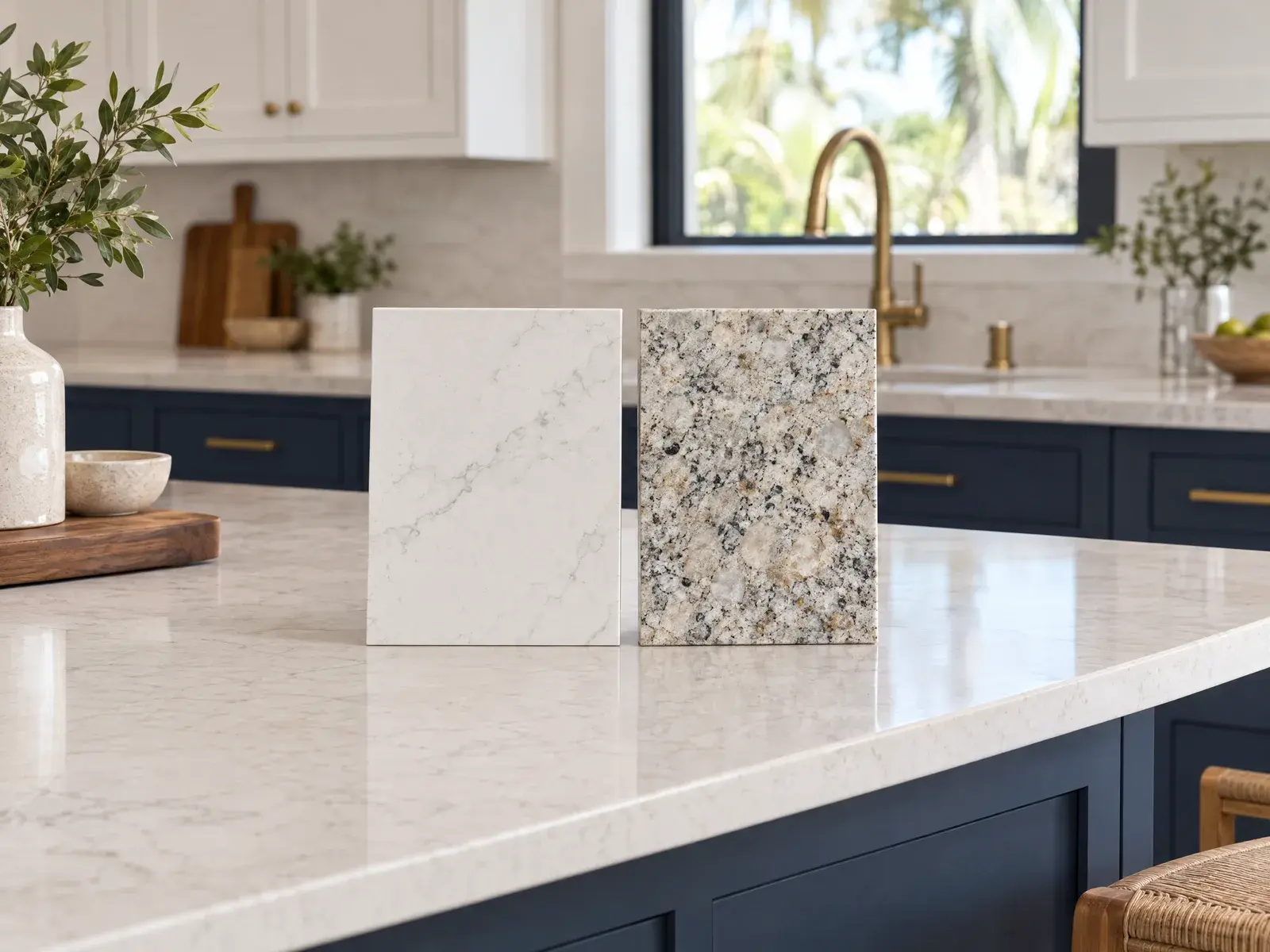
Quartz is consistent. The slab that arrives looks like the sample you chose, which makes it easy to plan around, and many quartz designs imitate marble without marble’s upkeep.
Granite is one of a kind. Two slabs with the same name can look quite different, so the usual advice is to visit the stone yard and choose the slab that will go into your kitchen.
Most kitchens need a seam somewhere. A uniform pattern hides a seam well. Strong veining, in either material, has to be planned so the pattern carries across it.
Deciding
Price depends more on the particular color and slab than on which of the two you choose. Countertops and backsplashes are among the partial kitchen updates we offer, and we can talk through both materials with samples in your own kitchen light.
Good to know
No. Quartz countertops are non-porous and do not need sealing. Granite is porous to a degree that varies by stone and is resealed from time to time.
Granite tolerates heat better than quartz, whose resin can scorch or discolor. Using a trivet protects either surface and is the safer habit.
Most quartz is made for indoor use, because prolonged direct sunlight can discolor the resin. A few manufacturers make outdoor-rated lines. Granite is not affected by sunlight and is a common choice outdoors.
Keep reading
This article is general guidance for homeowners. Every home is different, and what suits yours is something to look at in person.
Complete the form below or call us at (239) 295-8613 and one of our team members will be in touch to discuss your project and provide a free, no-obligation estimate.
Open form in a new tab Or call (239) 295-8613
Collaborative Construction